Tuesday, November 23, 2010

Government Programs Supporting Social Innovation

It is interesting to see government using its structure and position to create a platform to encourage entrepreneurs to devise alternatives to the way that government functions and how people receive needed services. The Office of Social Innovation in the White House is leading the government’s effort to fund and scale innovative social ventures. It has been exciting to read about the projects the office is funding. However, looking through the list, I was struck by how short it is. Eleven projects were funded in July 2010, as the article Social Innovation: Let’s hear those ideas, mentioned. The idea for the White House administering these grants is great, but where is the funding to allow widespread impact and truly identify the most effective solutions to our social ills? This seems to be another example of a great idea in theory, but the application has been not as effective as possible, thus limiting innovation. Another government program that fell short in funding is the governments work to recreate the Harlem Children’s Zone across the country, as President Obama campaigned upon. The Promise Neighborhood Initiative was slashed from President Obama’s request of $210 to $60 million, and thus not as many projects were funded. Until Congress realizes the role and need for social innovation, the necessary funding will not be allocated.

While I am disappointed by the scope and impact of the organizations currently being funded by the SIF, the government is funding social innovations in other capacities. One method I’d like to highlight here is through AmeriCorps. As the Center for American Progress’s report titled, Investing in Social Entrepreneurship and Fostering Social Innovation describes, “For entry level human capital, national service programs such as AmeriCorps have offered many social entrepreneurs a steady source of motivated entrants.” Furthermore, AmeriCorps has a variety of programs, some of which are social innovations in themselves. Take City Year (I was a City Year corps member for 2 years) as an example, the programs takes 17-24 year olds and places them into our nation’s lowest performing schools to serve as mentors, tutors and role models for a year of full-time community service. The model has proven successful and over 20 years has been established in 20 cities across the United States.

Another AmeriCorps program, which I came across doing research and still appears to be in development is called Innovation Corps, which fosters social innovation at the community level through the ideas of the corps members who are selected to participate. This program appears to have the potential to foster the cultivation of entrepreneurs, through providing financial support as well as through offering a network of pro-bono professional support, and events to introduce corps members to prospective supporters and implementation partners. I plan to watch this program and see how it unfolds.

How can government effectively foster social innovation in a time of budgetary constraints and bi-partisanship? How would widespread government support of social innovation and the cultivation of these entrepreneurs change the conversation on social innovation and the evolution of this field?

A huge first step in the creation of the Office of Social Innovation and Civic Participation

Much has been discussed about the role of the government in social innovation. Michele Jolin, laid the blueprint for what is now the Office of Social Innovation and Civic Participation (SICP). This office has been moving at a very fast pace, and this past July, they announced their first round of grantees. The office created a $50 million Social Innovation Fund, which is leveraged 3:1 by various foundations and philanthropists to spur development of non-profit social ventures. Understandably, this is a relatively small line item in our national budget. The greater impact of this office is its ability to convene and create opportunities for community partnerships.

This summer, I had the honor of interning at the White House of Faith-Based and Neighborhood Partnerships, which is located in the same building as SICP. During my internship, I had the pleasure to meet with Sonal Shah, the director of SICP, on few occasions. From our conversations, I can tell you that this is only an exciting first step in supporting social innovation.

In the coming months we will see more progress on supporting social innovation coming from this office. Key policy changes I would personally like to see are:

· More government support for for-profit social ventures (tax credits, subsidies, etc)

· Less paperwork to establish a 501(c)3 non-profit organization.

· Improve the Student Loan Forgiveness Program (SLFP) to support college graduates to pursue careers at non-profits or to start their own social ventures.

I am particular interested in the last point of government's role in spurring more young people into social innovation and nonprofits more broadly. I am tackling this issue through my social venture, by allowing young people to gain access to sponsorship for their volunteer service to help pay back their student loans and give back to their community. It also happens to be aligned with SIPC's mission to promote service.

Jolin also echoed this sentiment, in her article, On the Frontlines Innovating the White House. In this article she mentions that the White House, should foster partnership with Universities to prepare young people for careers in the non-profit sector; ensuring the student loan debt does not prevent qualified, interested young people from entering the non-profit sector.

My questions for you are:

What key policy changes, if any, would like to see from the White House to support social innovation?

What key policy changes, if any, would you like to see that increase civic participation?

Big G and SI: Expanding the Social Innovation Fund for For-Profit Social Ventures

The Social Innovation Fund is a government supported funding source for social non-profits to gain the necessary capital they need to get their feet off the ground and the ability to replicate their model around the country. One issue that has been highlighted surrounding this program, however, is the lack of start-up resources for social venture that are based under a for-profit model. Getting initial funding to get off the ground can be a daunting tasks for these organizations as well, however, they do not have the same access to governmental funding as do their non-profit counterpart. They do, on the other hand, have the potential to pay back money that they have received and may even have the ability to give an even greater return.

In a recent article, Harvard Business Professor Clayton Christensen argues that the government is losing out on great potential by not funding social venture based on performance and sustainability. He argues:

"This Office (White House) can use its convening power to help break though some of the toughest barriers that have long prevented marketplaces that can grow social innovations from taking hold, like the lack of metrics that enable us to know what works and the need to invest in "bottom up" versus "top down" solutions. It can help catalyze a shift in the social sector that would better guide funding and support towards social enterprises that have impact."

In his argument, Christensen creates three priorities for the Office of Social Innovation:

1. It must demonstrate a new way to solve social problems where government serves as an investor in innovations that are developed and identified by citizens outside of government.


2.  It should guide more social innovators towards "bottom-up" initiatives, in preference to "trickle-down" philanthropy.


3.  It should use the convening power of the White House to initiate a focus on impact and metrics.


With the creation of the Social Innovation Fund, it has become clear that government policy recognizes the influence and importance of Social Innovation in shaping how we should tackle some of the most daunting challenge facing society today. However, unlike the field itself,  the Social Innovation Fund seems caught in the old ways of doing things. Christensen continues his argument by describing the need for the government to evolve in order to spur a new wave of innovation and philanthropy that does not have to be incompatible with profit and business.

One of the primary ways of accomplishing this task will be the shifting of the metrics used to value impact and sustainability as we discussed last week. This reiterates the points that like innovation itself, we must continue to look for new ideas (many by giving a new face to proven techniques) to handle the opportunities that this movement of social innovation has brought forth.

While the merit of providing impactful non-profits with funding to expand their missions has huge value, the government should not limit its scope. The government should perhaps not blend the Social Innovation Fund into something that makes investments in for-profit social ventures, but create a source of funding for hybrid ventures that would provide a return on the government's money. With the resources available to the government, huge opportunity to generate lasting social change can be found.

I leave you with a few questions:

Does government even have a role in for-profit social ventures as they already have access to investor in the business world and can grow like any other business?

If the government did fund for-profit social ventures, how should it balance metrics for measuring financial success with social impact?


Monday, November 22, 2010

Harm in the Good?

Our readings this week focused on Creating Policies and Ecosystems for Social Innovation. An ecosystem is defined as “a system formed by the interaction of a community of organisms with their environment.” (Dictionary.com n.d.) If we apply this definition to the social innovation field, it requires that social innovation solutions must take into account the social, political, economic, cultural, religious, and other key factors that affect the lives of those they seek to help. Sadly, this is not the case as many social innovators, philanthropists, charitable givers, etc., embark on their efforts to improve the lives of BOP individuals without fully understanding the many facets of the environment that lead to their current situation.

Take for instance the story of Jason Sadler, an American businessman who embarked on a mission to send one million t-shirts to the poor in Africa. Despite the intended nobility of his idea, Sadler, a novice to foreign aid, was highly criticized by experts in the field. The reason behind this attack was that if successful, Sadler’s efforts had the potential to “flood the market with free goods [which] could bankrupt the [local] people who already sell them.” (Wadhams 2010)

What should be done if we want to prevent more Jason Sadlers, individuals with good intentions, but poor awareness? Should we enact regulations that call for individuals to do adequate research before embarking on social ventures? Should they be required to consult with nonprofits or government agencies on the ground in order to determine if their social venture will do harm or good? How much responsibility does the social innovation field have in this regard?

I say, much, for at its core social innovation does strive to improve the lives of those affected by societal ills. Thus, leaders in the field have a responsibility to enact policies to reduce the likelihood of Jason Sadlers negatively affecting the people they aim to help. Doing so will help ensure that the BOP ecosystem(s) is properly considered so that it is improved and not harmed.

Sources:

Dictionary.com. n.d. http://dictionary.reference.com/browse/ecosystem (accessed November 22, 2010).

Wadhams, Nick. "Bad Charity?" Time, March 12, 2010: 1.

Protecting the Bottom of the Pyramid...

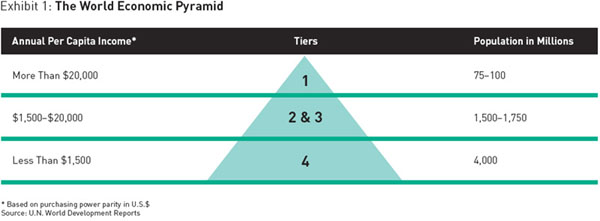
Benefits, untapped consumers, economic possibilities... this is the language most often used when discussing the BOP (Bottom of the pyramid). That 2.5 billion people worldwide who live on less that $2 per day. Though this is undoubtedly a group of people who are in desperate need of support, we must be wary of all those stating their willingness to "help" these people.

We have seen the work of people like Muhammad Yunus, of Grameen Bank, and all you could do is be intrigued by the innovation that led to such great outcomes. Because of Yunus, 7.35 million Bangladeshi's have received low interest loans allowing them to further develop their own income(s). Yes, this is a great social innovation that has benefited the intended audience but this is only one example. As stated by Aneel Karnani in Romanticizing the Poor

, this is not always going to be the case.

Though we promote the idea of fighting poverty with business--we do not acknowledge that oftentimes

"the poor lack the education, information, and other economic, cultural, and social capital that would allow them to take advantage of--and shield themselves against--the vagaries of the free market"
Though many would consider Karnani pessimistic and only dwelling on the negative possibilities of economic solutions to helping the world's poor, we must take heed to the information given. With the data overwhelmingly emphasizing the possibilities of profiting off the BOP, we must use our knowledge of the beast which is the free market and assure that systems are put in place to protect those who are most vulnerable--our poorest people. As Michele Jolin articulated in, On the Frontlines: Innovating the White House, much of the responsibility to promote social entrepreneurship should fall on our President and his or her White House. Jolin has been successful in her attempts as we now have a White House Office of Social Innovation and Civic Participation.

So we have seen widespread support for social innovation--particularly serving the BOP--but not enough has been done to prevent what Jolin explains to be a very real possibility--The widespread exploitation of an entirely new population, the BOP. So is Jolin being a pessimist, or is she completely rationale in her concerns? I ask, are we doing enough to protect the BOP? Is this a real issue? Should the new White House Office of Social Innovation make this one of its responsibilities? Or should we make the late Adam Smith happy by giving the free market a try at the BOP?

Exploiting the Poor or Offering Market-Based Products?

"The best way to alleviate poverty is to raise the real income of the poor by creating opportunities for steady employment at reasonable wages." Annel Karnani Annel Karnani's article, "Romanticizing the Poor," in the Stanford Social Innovation Review discusses how poor people often suffer more deeply than their wealthier counterparts by making poor decisions, usually in an attempt to escape their realities of poverty. And corporations, universities and governments are doing their part in making sure that it stays that way by targeting the BOP as consumers rather than focusing on sustainable revenue generating businesses that would allow them to actually increase their income. In fact, some corporations and businesses are exploiting the BOP so that they are able to profit on the desperation that poverty entails. Several examples illustrate this in Karnani's article, from the acknowledged use of tobacco and alcohol that permeates all socioeconomically challenged people to the specifically inane skin whitening lotion that is targeted to women in over 40 countries. The justification for targeting specific populations with market-based solutions is that if consumers had more choices to pick from then they would make better decisions. However, Karnani states, "Yet these advocates do not acknowledge that the poor lack the education, information, and other economic, cultural, and social capital that would allow them to take advantage of - and shield themselves against- the vagaries of the free market." It does not seem that the poor haphazardly squander what little income they have on frivolous items, but that they lack so many resources, including emotional safety regarding their poverty and lack of options that it is easier to simply pick instant gratification. Karnani offers some convincing evidence and Nobel Peace Prize economist Amartya Sen agrees, " Deprived people tend to come to terms with their deprivation because of the sheer necessity of survival, and they may, as a result, lack the courage to demand any radical change, and may even adjust their desires and expectations to what they unambitiously see as feasible." It is easy for corporations, politicians and society in general to simply blame poor people for their poverty, however, that is an easy answer for a difficult problem that those casting blame might have never faced - desperation is a powerful emotion. On a personal and empathetic level, I found myself getting frustrated FOR the poor. I recalled moments in my life, though not nearly as desperate and despondent as what the majority of the population in this article face, when I worked really hard on a daily basis and never felt like I was seeing progress. When my level of frustration and disgust reached the level of, "what's the point? I'm not getting anywhere," and suddenly, it made sense to me why the temptation to spend a significant portion of income on cigarettes, alcohol, lotion or a party might make sense. Karnani states, "In addition, poor people more often encounter stressors-including hunger, pollution, crowding and violence-that lead them to act in ways that may alleviate suffering in the short term, but hinder economic prosperity in the long run." If poor people are unable to make good decisions because of their lack of resources and the economic world creates unwanted or harmful products for the sole purpose of increasing sales, then where does the responsibility lie? If the poor truly feel that they have no ability or right to demand quality products that contribute to their quality of life, then who does? And if we are able to relate to that desperation, even in some small way, then how do we justify solely blaming the poor for the bad decisions that they make regarding their income?

B-Corporations and Stakeholder Capitalism

During lecture last week Professor Zak mentioned the idea of the B-Corporation in the U.S. and how it would be akin to the Public Interest Company in the U.K. Both concepts were also mentioned in the article, "Social Innovation: Let's hear those ideas," from our weekly readings. Structuring as a B-Corp or PIC would seem to give a means for a company to formalize its social impact beyond some statement about "corporate social responsibility." This is especially important since, as noted in Aneel Karnani's article "Romanticizing the Poor," "CSR is little more than a cosmetic treatment."

So what exactly is a "Benefit Corporation" or B-Corp? As it stands right now, it is not a nationally-recognized legal corporate structure, rather it is a type of certification that a company can receive. The certification is issued by B-Lab of Berwyn, Pennsylvania. It is good for a period of two years and the companies pay a fee to hold the certification. After the two year period is over and at random during that period, the company is subject to audits by B-Lab in order to ensure they are complying with the B-Impact Ratings System.

Companies are rated by B-Lab on how well they take into account the interests of all their stakeholders, rather than just their shareholders. They are evaluated on things such as how they treat their employees, the level of transparency in their year-end reports, their impact on the environment and their communities. It appears to give companies a structure to formally account for creating value in other ways than just returns on investment for shareholders. The companies are required to alter their corporate charters to consider these returns to stakeholders in addition to returns to shareholders while making decisions. In other words, a B-Corp includes the external benefits it creates to society in its bottom line or its triple bottom line, as the concept is often termed.

Though the certification has not been legally recognized on a national level, several states have adopted the system and Philadelphia has provided tax incentives for B-Corps and their investors. Understandably, B-Lab seems to be spearheading these efforts for recognition of the B-Corp structure.

While pushing for national, legal recognition makes sense, what is interesting about the development of B-Corps is that it wasn't something handed down to the business world by the government. Its a movement that has come from the business community on its own and represents a shift in the idea of what capitalism means. This article does a nice job of explaining the history, but as one lawyer working with B-Lab puts it, "I think government can't solve all our problems and the private sector is a much bigger player in the economy anyway. So the idea is, if we can get businesses to behave in a different way, we can actually harness the power of the free market to make social changes, which would be more efficient than having change come down in the way of government mandates."

So what happens when government does start to legislate this movement? It seems desirable for the government to create incentives for investment in B-Corps, but how can that be done while keeping investors' expectations realistic? Does the answer lie in some type of subsidized investment strategy, similar to the social impact bond? Where does the balance lie? And in light of our readings last week regarding the difficulties in measuring social impact while more companies move towards being certified as B-Corps, how can B-Lab ensure their ratings system is accurate and fair?

Let me know what you think.

Thanks.

-Kyle

Chicken-Egg conundrum in social innovation funding

Our reading of this week presented us how government support for social innovation. The most notable piece is the proposal for establishing office of social innovation and civil participation by Michele Jolin in 2007 and 2008.
She believed the government could serve in the following areas:
1) Designing tools to direct federal funds to nonprofits that have demonstrated results
2) Serving as a catalyst for cross-sector partnerships between the non-profit sector, corporation, and the government
3) Exploring possible revisions to the tax code
4) Coordinating with the Corporation for National and Community Service to find ways that national service can leverage the work of social entrepreneurs and build the capacity of the nonprofit sector.
Fortunately, the office was established soon in 2009. The one of the most notable piece of their initiative is creating Social Innovation Fund.which will identify promising, innovative solutions that potential to scale to meet the needs of other communities. However, this statement makes me think about the difficulty I witnessed in NGO and social enterprises field of China.
Most case is like that: a social enterprises from particular area seeking a solution to a certain problem, but was stopped out of lacking money and human capital. He can't get money from competitive fundraising with FAMOUS BIG NAME NGOs or social enterprises with strong background, for example, the founder from Mckinsey. Therefore, he can't scale up his business and impact with limited resources.
If government only support those who has already demonstrated results, it will most likely that government always funded big names. It will also leads to the Matthew effect in social innovation field.
I believe the promising reason that social innovation field carries is because it release innovation of every single one. If funding problem could cause more gap between the strong NGOs and small NGOs, it would results in a new unbalance.
My question for this lecture:
1) How could government balance this chicken-egg conundrum and choose the most suitable one to fund?
BTW, I posted a poster of Empowering Chinese Social Enterprises Leaders program initiated by Clinton Global Initiative.

What Role Should Governments Have Fighting Against Poverty?

From the readings of this week, I would like to try about two topics related with the role governments have in developing countries when fighting against poverty. I think that governments should have a relevant responsibility in developing countries to guarantee a minimum standard of opportunities for all citizens, mainly building up infrastructures and guarantying health and education accesses. The problem is that developing countries’ governments lack the resources for this. Free trade agreements and outsourcing offshore have weakened the position of governments. In order to attract investments and control inflation, governments reduce taxes and consequently they have less money to spend in public services. Actually, developing countries are competing to attract foreign investments and they do it cutting taxes to corporations and eliminating capital controls. Today, governments have fewer resources than some decades ago. Thus, we have a big problem and I think that the only possible solution at hand is Social Enterprise.
The first topic I will analyze is from the article India Asks, Should Food Be a Right for the Poor?  By Jim Yardley. The author suggests that the best way to fight against poverty is not with control prices or subsidies, rather through vouchers or direct transfers of money to the poorest people. Mexico has applied with partial success this kind of direct transfers to poorest people in rural areas since 1994. The program rules are that mothers receive the resources, the amount of money varies depending of the number of children at the household, and to continue receiving the support, children must be enrolled in primary schools. The program has succeeded reducing hunger and increasing school attendance in depressed regions. For instance, in 1996, 37% of the population lived under extreme poverty conditions; in 2006 it was only 13.8%. Nevertheless, the program has only partially succeeded because the sources of the problem are still there: lack of jobs and economic growth. In 2009, poverty in Mexico surmounted again to 18.2% due to the economic crisis and prices increases.
Today, the first generation of beneficiaries of direct transfers in Mexico has 15 years old; they went to school and their families improved conditions thanks to government’s support.  The Mexican government and the society promised those kids that going to school they would improve their opportunities in rural areas or will get better jobs with education, but that is not true. Not the private sector either the government have been able to generate the needed opportunities for those youths. Well, the question is what can we do now? Again, I think that social enterprises are the only solution at hand to fulfill this gap. At least we should try on.
This is related with the second topic of the readings I would like to try on.  I disagree with Annel Karnani conception’s about poor people. In some way, he thinks that poor people are stupid.  He argues that “romanticized views of BOP people are harmful because they lead to states with few legal, regulatory, and social mechanisms to protect the poor, as well as to rely too heavily on market solutions to poverty”.  The author forgets that governments in developing countries usually lack those mechanisms. Governments don’t accomplish those tasks not because they do not want to, but because they cannot. They don’t have the resources either the institutions to enforce the law properly.
Annel Karnani argue that poor people is not rational because they spend money in alcohol, tobacco or treats instead of food. Thus, society should take care of them to teach them how to spend their scarce resources. The author doesn’t have data to support this kind of claims. I just can say that we cannot generalize; his claim is as ridiculous as to say that U.S. costumers are not rational because they spend more than they can afford in credit cards or mortgages they will not pay. Then, the government should take care of mortgages and credit cards.  In my experience, poor people are as rational as rich people; maybe they lack education but not common sense. As well, poor people usually have faced so harsh conditions, that when they have one opportunity usually they don’t waste it.  
The author also forgets other benefits the market leads to poorest people. Markets also bring infrastructures, information and communications. Finally, I think that there is a gap between what government should be doing and what they are doing. The problem is that the economic model we have pursuit have weakened governments’ position. There is a hole and just a few options to fulfill it. At least we should take the risk with social enterprises.

Sunday, November 21, 2010

Create jobs, not an illusion of prosperity

Aneel Karnani accurately addressed and expanded on the concerns I expressed in class last week about imposing social innovations on the poor. In his article, "Romanticizing the Poor," he identifies the roots of poverty: lack of education, no access to economic capital or valuable information.  His sentiments make me think of the malnutrition problem in Africa.  The root problems are fertility rates and a poor economic structure, which is ultimately causing children to die.  It seems that social advocates need to address these concerns first (although easier said than done) before implementing a market-based approach.

Karnani strongly suggests that job creation will help to alleviate poverty. I agree that giving the poor employment opportunities is an effective approach, as it gives them the choice to take control of their own lives and better their situation. If more people are working, this may also decrease the amount of people abusing drugs and alcohol.  Working also gives people of sense of purpose and provides more opportunities for future spending and the ability to provide for their families, if they choose to do so.  In a previous blog, I reflected on La Fageda, which employed mentally ill patients to work at the dairy. Same is true for the poor; they are PEOPLE who should have the opportunity to productively contribute to their own livelihood, not be exploited or controlled by others.  

In another Stanford article entitled "Microfinance Misses its Mark", Karnani gives various reasons why microfinance is not the solution to poverty.  One reason in particular is about how it allegedly empowers women, although men almost always control the money in the household, so women have a false sense of empowerment.  How does this affect the family structure? I imagine this creates more problems that microfinance advocates don't think about. 

Karnani's solution is more government involvement and oversight.  This is a scary thought, considering the statistics we read about in the NY Times article about the corrupted Indian government. Government involvement would have to depend on the country and how stable it is.  One would love to believe that the government has its people's best interest in mind, although that's hard to come by these days! 

How can social innovators assist governments with employment-focused initiatives to help tackle poverty?  Hopefully the Center of American Progress and the White House Office of Social Innovation and Impact will consider Karnani's work. 

Can the Poor be Saved from Poverty...and Corruption?

I had no idea that within India’s food system “70 percent of a roughly $12 billion budget is wasted, stolen or absorbed by bureaucratic costs,” as was stated in Jim Yardley’s article, “India Asks, Should Food Be a Right for the Poor”. Although, I realize corruption exists everywhere, it made me think is social innovation more vulnerable to corruption? After discussing SKS Finance briefly in class last week, I started to see a pattern of corruption and greed take over the citizen sector. What once began as a service to lift people out of poverty has now potentially caused a microcredit crisis, as was reported in The New York Times last week. So, how can corruption be curbed?

This week’s articles centered around government, and how federal policy and actions need to be readjusted to support the scaling and growth of innovation, such as investing in high-impact non-profit solutions, supporting startups and new innovation, supporting efforts to develop human capital and creating a favorable tax and regulatory environment. While I feel that the government, through the Office of Social Innovation and Civic Participation, has demonstrated increased momentum toward innovation, specifically through its Race to the Top grant program, the issue of corruption still exists. Whose responsibility is it to prevent corruption? Government? Individuals? Organizations?

I came across an interesting social venture, The Broccoli Project, while browsing my daily twitter feed. The Broccoli Project uses biometric and mobile technology to measure the impact of social programs in South Africa. More simply, fingerprints are used to identify individuals who exhibit positive social behaviors, and are then rewarded with aid money. This technology helps to reduce corruption through the fingerprint-clad security system. However, although the fingerprints are used to monitor positive social behaviors, and are then used to reward individuals, the payment is still in the form of a bar-coded voucher, which could open the door to possible corruption. Nevertheless, the Broccoli Project has developed an innovative technological means of not only reducing corruption, but also encouraging positive social behaviors, and allowing for tracking and measurement of monetary aid.

(Source: http://www.broccoliproject.org/About.aspx)

While it seems like the Broccoli Project is on the right track to helping the poor, is this just another innovation that is taking advantage of an unknowing and irrational “consumer”? In the “Romanticizing the Poor” article, Aneel Karnani argues that bottom of the pyramid “consumers” are in fact not able to make rational and smart choices. Therefore, is something like the Broccoli Project taking advantage of individual privacy rights? Would you be willing to give your fingerprint as a means of receiving payment? Fingerprint ATMs? Does social innovation sometimes blur the line of what is ethical?