Tuesday, November 30, 2010

Is the X Prize Foundation doing enough?

When reading the X Prize article, I found myself intrigued by the notion of using competition to fuel social progress. Like Vander Ark, I agree that “a prize mechanism is very useful” when dealing with ambiguous problems (15 minutes, 2008). This intrigue turned to disappointment, however, upon review of the foundation’s website.

Despite Vander Ark’s expression of confidence in the foundation’s ability to “identify several entry points where prizes can make a big difference,” ‘Education and Global Development’ is the only of the group’s four prize areas (energy and environment, exploration, education and global development, life sciences), for which there are no planned future prizes listed on the organization’s website (15 minutes, 2008). This speaks to either a lack of interest in the educational sector or, as Vander Ark referred to in the article, evidence of a lack of investment “spent in this field because the returns to investors have been weak” (15 minutes, 2008).

In either case, it is disappointing that in the 2 years since the article was published, the potential to improve educational issues through competition that Vander Ark spoke of has remain untapped. This is especially true due to the widespread education and literacy issues currently present within both the developed world, such as the US, and developing countries.

Although developing solutions to issues related to getting laymen to the moon or producing a car with lower fuel emissions is arguably more exciting than coming up with a sustainable method of educating inner city children, I contend that the latter is equally if not more important (Home Page). Thus, I hope that the X Prize Foundation soon lives up to Vander Ark’s words and funds a prize competition aimed at “focus[ing]…attention on an important education goal” (15 minutes, 2008).

As of now, the foundation’s website contains no concrete evidence of plans for doing so. They are however soliciting ideas for the focus of such a competition, be it on the national or international scale. I encourage interested parties to participate in this solicitation. Ideas can be submitted at the following link: http://www.xprize.org/x-prizes/propose-an-x-prize

Sources:

15 minutes. (2008, Winter). Stanford Social Innovation Review , p. 3.

Home Page. (n.d.). Retrieved 11 30, 2010, from X Prize Foundation: http://www.xprize.org/

(PC - PR) + (SIB - GR) = PBI

At Carnegie Mellon we try to explain everything through mathmatical models. That's an exaggeration, of course, but our quantitative focus did help me have some fun with a few concepts we are covering in class.

The equation above stands for:

(Philanthrocapitalism - Philanthropist Risk) + (Social Impact Bonds - Government Risk) = Prize Based Innovation

This week, while reading an interview with Thomas Vander Ark, president of the X Prize Foundation , in the Stanford Social Innovation Review I learned about prize innduced innovation. During the read I could not help thinking about the similarity of Social Impact Bonds and X Prize's approach. Both innovation methods aim to create solutions to challenges that past efforts have failed to overcome. However, by creating a prize model the risk of failure is taken off the shoulders of the government and instead shouldered by the contest participants. In venture philanthropy the risk of a venture is taken on by the granter whether is be a venture capital fund or foundation and off of the entrepreneur / innovator. In this model, all the fund's chips are tied up with one team.

Prize based innovation takes the constraints of SI bonds and venture philanthropy and throws them out the window. No limit on number of teams. No risk to public dollars or welfare. But giving up constraints also means giving up control. Prize based innovation cannot say, here's an amazing group I want to get behind with my dollars. There is limited oversight. It takes an adventurous and humble spirit to run a innovation fund based on a prize structure, one not needing to take the credit for an advancement. Do people remember the Orteig Prize ? No. They remember Charles Lindbergh.

Our additional readings this week looked at the development of what has been dubbed, "the world's first zero-carbon city". The upcoming 50,000 resident city of Masdar wil be powered by wind and sun energy while becoming a global leader in CO2 trading. Masdar is located in oil rich Abu Dhabi. So far the emirate has contributed $15 billion to Masdar's development. This resembles the prize based innovation pursued by X Prize, except the UAE is pursuing the challenges on its own without putting out the call to other governments in the world to compete.

Over the last decade or so the world has seen the UAE and Abu Dhabi throw around a lot of money to accomplish incredible feats. In door ski mountains. Man made islands shaped like a map of the world. Plans for the first rotating tower. They've been putting their relatively recently acquired wealth to innovative use.

When I look back through history, it was the first half of the twentieth century that the world looked at the United States as the birthplace of aweinspiring innovations. The Wright Brother. Henry Ford. Thomas Edison. During this era the United States was experiencing relatively new levels of wealth. As the USA has gotten used to its place as a world leader has it become too conservative in its scope of innovation? One only needs say the word "Internet" to seemingly leave my question obsolete. But have we reached the levels we once imagined for ourselves? What happened to the Jetsons? What happened to my rocket car? Hopefully, X Prize is setting up a contest , but if the present is any predictor, the UAE may beat them to the punch.

An Ethical Dilemma of Inequality and Exclusion

The readings for this week made me think about an ethical dilemma between poverty, inequality and social innovation. In the New York Times’ article In Arabian Desert, a Sustainable City Rises, by Nicolai Ouroussoff, after presenting the innovative city-project of Masdar and its benefits, the author reflects about “the growing division of the world into refined, high end enclaves and vast formless ghettos where issues like sustainability have little immediate relevance”. Ourousssoff stresses an important point: innovation can entail exclusion and inequality.
During these seven weeks of course, I have learned the basic principles about l Innovation. Well, I think that the discipline focuses in poverty reduction, but inequality is hardly mentioned. Actually, I am concerned that some innovations reduce poverty, but they increase inequality. To clarify my point let me divide the successful cases of social innovation into three categories: 1) Social Innovations that reduce poverty; 2) Social Innovations that reduce poverty, but increase exclusion; 3) Social Innovations that reduce poverty and inequality.
In the first category, I would include for instance the French peanut butter paste to battle hunger in Africa. It is a social innovation who fights against poverty, even if it not reduces inequality directly.
Regarding the second category, this is which I distrust for a matter of ethics. It refers mainly to products that are price discriminating. For example, the DANONE yoghurts of 10 cents in Africa, or the adjustable glasses for poor people. In my opinion, they increase exclusion in the long term, because there would be two kinds of goods, one for the rich people and one for the poorest. It is unfair. The solution should be that both (poor and rich) can afford a visit to the optometrist, or both can buy the fancy yoghurt. The solution in this case should be policies to improve health and jobs. In the long run, these kinds of social innovations are not solving the sources of the problem. Contrary, they increase the sense of exclusion in poor people, and it can be dangerous for social stability.
The projects that reduce both poverty and inequality are the third category of Social Innovation. In this category, I would place the initiative of Aravid Eye Care Systeme in India, to make eye surgeries. People receive the same service, independently of their income, and it serves to reduce at the same time inequality and poverty.
Moreover, most of innovations related with information technology fall into this category. One of the biggest sources of inequality in developing countries is the unequal access to information. Poor people don’t have complete information from the markets; indeed they cannot take the best decisions. Without information, markets don’t work properly. Innovations that increase the amount of information available for marginalized people, or increase the education level to interpret that information, succeed reducing both poverty and inequality. For example, the new uses for mobile phones, such as the Farmer’s Friend or Google Trader or banking services follow this pattern.
To conclude, in the conceptual frameworks we studied at the beginning of the course, I did not find an explicit distinction of projects in function of inequality reduction, neither in the readings about how to measure social impact. Nevertheless, to attain long term solutions to development problem, it is essential to distinguish between social innovations, or social enterprises that reduce inequality from those who do not. Social impact measures should take this into consideration. Did I miss something in the readings? Do you think that Social Innovation should focus only in poverty reduction and not inequality?

Prize Model for Social Problems?

Competitions can bring out the best in us. The result of the X Prize competition was the most efficient, low-cost method for transportation to space. Using the prize competition model to solve illiteracy through education is a creative example of how to find the best way to solve the problem.

After reading the article about Thomas Vander Ark and the X Prize Foundation, my first question was, why aren't there more global prize competitions to solve social problems?

The article poses several reasons to counter this question but one stuck out to me: the return of capital to investors has been weak. Finding a low-cost, efficient solution seems to be the problem with many social ventures. Funding these ventures is always an issue.

Safe drinking water is a problem for 2 billion people in the world. One example of the prize competition that might prove successful would be to provide safe drinking water to these people.

Why can’t we create an effective market system that allows individuals and corporations to donate money to these social ventures? As we discussed in class, when the U.S. government provided tax benefits for charitable contributions the floodgates of capital opened up. What if a website was created where individuals and corporations could donate capital to the winners of each social venture prize competition to expand relief for such programs? Companies could also sponsor a water purification device in a community, like “adopting a highway” currently exists in the U.S. We might even use the idea of paying for carbon credits to extend beyond just a company’s carbon footprint, but to where companies could pay for any overconsumption.

Although challenging, with the creation of an efficient capital market system to fuel products and ideas from prize competition winners in social innovations, what social problems couldn’t we solve? How can we best use that system to generate returns so investors are likely to contribute?

Still Moving Toward Ecotopia...

Masdar City is the next experiment in designing an environmental utopia or Ecotopia, coined after the 1975 Ernest Callenbach novel. The 2.3-square mile community will not allow cars and will have narrow pedestrian streets with shaded photovoltaic panels to cool the less than 50,000 people who inhabit it. Masdar City will be fueled by solar energy, will recycle and compost all of its waste and will grow its own food. Water will be supplied from a solar-powered seawater desalinization plant. Food from Masdar City will be grown in the local greenhouse. In short, the municipality will be self sufficient and environmentally efficient. Masdar City is described as a "hub" for academic and corporate research. There have been other ecotopian towns who have served as a platform for ecotopian cities, with mixed results. Although the initial attempts have had issues, I think that the advantages outweigh the disadvantages. It is well known that we need to explore more environmentally sustainable options and start weening ourselves off the traditional methods of energy. It is an established fact that the natural resources we have been depending on for so many years are running out and we are damaging the planet in the process. The knowledge that building and sustaining Masdar city will provided advantages well worth the venture of constructing it.

Competitions, Housing, and Final Projects

I've become very familiar with design competitions over the years. As an architecture student, they were part of the curriculum and culture of the profession. Often times they resulted in outlandish solutions that neglected to consider and address how the solution could be implemented in the real world without requiring some drastic overhaul (Masdar City, anyone?). But, they make you think about, or more importantly re-think, what's possible. What was so appealing to me about the X-Prize Foundation reading is the way they are able to both push the envelope of what's possible and provide a structure to make those ideas a reality.

In researching our group project on low-income and modular housing, it seemed like much of the lack of innovation in that area was due to a lack of incentive (as stated in this paper). I was able to find a recent design competition, Texas Grow Home, that attempted to address the housing crisis in the gulf coast of Texas. The winning designs were then to be prototyped and hopefully used in the future as permanent housing for disaster victims. The main incentives for entering and winning the competition seemed to be more prestige and altruism because the "award" was a total of $8,000 for the winning entries. Some high profile architecture firms did enter the competition and there were a few novel ideas in the winning entrants, but nothing that was truly revolutionary. As much as we want to believe that money is not a more powerful motivator than the need to do good, I'm left wondering if the prize had been $1 million would there have been more entries and more revolutionary designs.

As an aside, these designs differ from our group's project in a few ways. Perhaps the most notable difference is the site. Because we are dealing with an urban infill situation, it is difficult to use large modules due to the size and constraints or obstructions (e.g. power lines, neighboring structures) of the site. Whereas once a disaster happens and land has been cleared, the sites are largely unencumbered and free of obstructions. Additionally, the weather around the gulf coast doesn't require a continuous foundation to withstand the freeze/thaw cycles of the seasons we experience in this area.

What is so beautiful to me about the way the X-Prize Foundation operates is the competition model. They are able to get such a higher yield for their "donation" by structuring it as a competition prize. Their foundation has reached a level of prestige that now carries a built-in audience. However, regardless of the competition sponsor a million or multi-million dollar prize is going to attract attention. My questions are about what happens once the idea is out in the world.

The Link Between History and Innovation

The concept of a city that runs entirely on solar energy and in which cars are not permitted is a bold and ingenious one. Still, I must admit that I was not too surprised by what I read about Masdar. It is not that the idea of such a city existing anywhere on the planet is not in itself surprising; for anyone to make such an argument is ridiculous, to say the least. I failed to be surprised by most aspects of Masdar only because of the great number of other similarly innovative concepts to which this course has thus far introduced us. After being exposed to the idea of peanut butter paste as a panacea for world hunger, a stairmaster that waters crops and a car that costs less than the MacBook I am using to type this post, a city that uses entirely renewable power sources is, dare I say, banal. Well, maybe that’s a stretch. In all seriousness, however, not much really jumped out at me about Masdar city. There was, however, one aspect of the project that gave me pause: The city is to incorporate aspects of other great cities throughout history. I was a history major in college and never miss an opportunity to extol the merits of a strong knowledge of past events. However, the idea that a nexus exists between history and innovation seems, at least at first, a bit counterintuitive.

The way in which history and innovation fit together, however, became clear to me when I realized that no innovation is ever completely original. Every new technology, no matter how ingenious, makes use of some technology that is already in existence. Innovations, put quite simply, are improvements. A clear understanding of the techniques and inventions of the past, therefore, is not just a benefit to the innovator, but a requirement of him or her. An article published in 2009 by Siftstar.com, a site run by an economist, speaks to this point.

Some questions for consideration are: How can we motivate aspiring innovators, in particular aspiring social innovators, to study history and thereby become better equipped to undertake projects that make a difference? What other innovations besides Masdar city employ techniques and ideas that were used hundreds or even thousands of years ago?

Monday, November 29, 2010

Incentives Sparking Innovation

From the Orteig Prize to recent X Prize-- you almost have to stand in awe as you see what "regular" people can create when someone offers some incentive to take a risk.

While there have been innovations like that created by the winners of the X Prize, pictured to the right, it as also been stated that these single innovations are meant to spark much larger change. As our reading focused on the "larger change(s)" that we speak of such as: Masdar City--we see just how far innovation can go. In what we can call an environmental utopia, Masdar City, is a tree-huggers environmentally friendly person's dream.

No one can deny the innovativeness of this proposed city and it led me to stumble on another miraculous mission, also being born in the desert regions of our planet. Tree-hugger continuously posts radical moves in the mission to become more environmentally friendly. Below is a video that shows one of the most radical attempts to date. Though this is only in the planning phases, the thought of powering our world using SAND, yes SAND!, is a pretty amazing thought.

The Sahara Solar Breeder Project is committed to finding a way to using the Sahara Desert as an energy source. The plan is to use sand and solar energy to provide massive amounts of energy production by 2050 [around the time when those oil wells will start to run dry]. This plan is far fetched but is being backed by great minds in Japan and Algeria. Please take a few minutes to watch the video as my luddite attempts to explain will only cause confusion.

It has been stated that $2 million will be put up by universities towards research but let's hope that somebody like Thomas Vander Ark will find interest in this endeavor. It seems that $2 million is all the money on the table for an innovation that could possibly change the world, so is Vander Ark right to say that Prize philanthropy could fill the gap? I ask, will a prize take this from tree-hugger talk to a real race to see this come to fruition?

Equal Opportunity for Entrepreneurial Solutions?

My most recent professional experience was in corporate philanthropy, and I hope to make my way back into philanthropy at some point in my career. When reading through the “X Prize Foundation” article, I became a believer in Thomas Vander Ark's model of prize philanthropy. Prize philanthropy spurns innovation, and only rewards winning (successful) solutions to problems (so far, only technical, not social). McKinsey & Company gathered data from drawing on academic literature, interviews with analysts and practitioners, surveys of prize sponsors and competitors, databases of small and large awards, and case studies of twelve effective prizes to produce lessons from a range of sectors, goals, and prize types. The 2009 report acknowledged the importance of prize philanthropy as a true and proven method for tackling tough solutions and igniting innovation. As was referenced in the “X-Prize Foundation” article, the Google Lunar X Prize attracted interest from more than 125 teams in more than 25 countries. All evidence points toward a healthy and thriving method for innovation;However, I am slightly troubled by the economics of opportunity to engage in prize philanthropy.

When I was a senior in college, my economic thesis studied gender behaviors related to competitive environments. As a longtime athlete, I though it would be interesting to test the stereotype that men are more competitive than women. Throughout conducting an economic experiment that tested risk profiles of men and women athletes, and after controlling for demographic information, I found a statistically significant relationship among male athletes and their increased likelihood to enter into competitive situations as opposed to female athletes. As a disclaimer, this analysis is restricted to the population sample taken from my undergraduate college. However, I couldn’t help but think about the type of person, or type of entrepreneur or social innovator, who is more prone to capitalizing on prize philanthropy, such as the X-Prize. Are prize philanthropists inclusive of all types of innovators? Should prize philanthropy be all-inclusive?

If the assumption is made that women are more risk averse, and will behave accordingly, this could result in less entrepreneurial solutions for social problems, since prize philanthropy is said to motivate increased innovation. A risk-averse individual would probably prefer to continuously apply for traditional philanthropic funds, knowing there is a greater chance of receiving a grant award. On the other hand, a high-risk profile individual would be willing to forgo an expected financial payment in favor of an even greater monetary award celebrated with prestige. So, how to test this theory? In a June 2010 Erasmus Report for Young Entrepreneurs, it was found that only 39% of new entrepreneurs are women. Evidence shows that females are underrepresented in riskier professions – what will be the consequences for the social sector, and how might this impact access to diverse and innovative social solutions? Is there a way to encourage entrepreneurial thinking and innovative mindsets in a less competitive and risky approach? How should traditional philanthropy evolve to force the citizen sector to become more solution- and results-oriented?

Innovating America


Throughout this course, we've read a lot about innovations being used in developing countries and the importance of stimulating the bottom of the pyramid.  I've felt somewhat removed from this, as it feels too far away for me to grasp and really see the results. Having said that, I'm curious to learn more about innovations that have impacted or will impact our country in positive or negative ways.  I was able to find two ventures that some folks may or may not be familiar with:

Code for America
Code for America connects city governments with Web 2.0 experts to help them work around budget cuts, out-of-date information systems, and huge tax increases. Ultimately their services help governments help the citizens by using web technology in anyway possible.  2011 will be their inaugural year with 4 selected cities: Boston MA, Washington DC, Philadelphia PA, and Seattle WA.
Sources:
http://www.justmeans.com/Code-for-America-Social-Innovation-Save-America-s-Cities/18404.html
http://codeforamerica.org/what-we-do/

Living Cities
Established in 1991, Living Cities is a philanthropic collaboration of 22 of the world's largest foundations and financial institutions. Their goal is to improve the lives of low-income people and to revitalize the urban areas in which they live by investing in social innovations and projects in US cities.
Source http://www.livingcities.org/

These initiatives reinforce my hope that the issues and hardship facing US cities are just as crucial as those in developed countries.  On 10/28/10, Living Cities invested $80 million in 5 metropolitan areas to tackle problems affecting low-income residents as part of their Integration Initiative.  Living Cities CEO states: 


“The Integration Initiative was designed to take advantage of all we have learned about catalyzing changes in cities over the past 20 years,” said Living Cities CEO Ben Hecht. “Cities need flexible resources to help them move innovation from the periphery to the mainstream, to integrate change across disciplines, geographies, sectors and funding sources.”


Source: http://www.sustainablecommunitiesandstates.org/2010/10/living-cities-invests-80-million-in-projects-in-baltimore-cleveland-detroit-newark-and-twin-cities/


After reading this week's article on Masdar, I wondered how this eco-city could NOT be seen as socially exclusive.  I have to ask who will reap the benefits of its "social impact"?  This is one of those questionable endeavors that leaves you somewhat confused and curious at the same time. 


Overall, I am impressed to read of the many levels of social innovation and enterprise that exists in America as well in foreign countries. I've realized how subjective this field can be with its many dimensions, stakeholders, and 'clients.' From cell phones to Plumpynut, I leave you with this question:  


What innovation(s) should receive the top prize for societal impact? (That could be a whole other course!) 

Can Social Innovation be more Inclusive?

When I contemplate the future of social innovation, I don’t necessarily focus on the impressive technological advances, such as flying cars or green cities. I wonder how the field of innovation will become more innovative itself. I began to think more about the exclusivity of the field after reading “De-Colonizing Social Innovation” by Jackie Copeland Carson, the research director for the Institute for the Future. Over this half of the semester we’ve read many articles and watched videos exposing us to numerous social innovators. Yet the field still does not strike me as particularly inclusive. Not all, but many of these innovators are examples of the “rich westerner” solving the problems of the poor in developing countries. While we’ve gotten better at trying to understand the culture and circumstances of the people we strive to serve, there still seems to be restrictions on who can participate in social innovation. Only those with understanding of advanced technologies and/or access to significant capital are able to see their ideas create impact. How can we make the field more accessible to those we are trying so hard to help?

While reading about Masdar, I found it particularly interesting that some of the architecture innovation were reexaminations of historical city plans and ways that indigenous peoples were living in order to combat the climate without expensive technologies. These low income communities were able to find solutions for themselves without the intervention of more knowledgeable and tech savvy foreigners. How can we learn from this historic example? How can the innovative solutions in practice in low income and low technology communities be included in the canon of social innovation? How can these unknown everyday innovators be included in the growing field of social innovation?

Social Innovation's Unintended Consequences

I was a bit blown away reading about Masdar City; it sounded like something straight out of a science fiction movie. It is exciting to think about the possibility of creating a new city based on lessons learned from both modern and historic cities around the world. In addition to using cutting edge technology, the architect of Masdar is looking back at old Arab settlements to see how cities were kept cool before air conditioners in cars and buildings, in what can be an unbearably hot climate – a reminder that sometimes what is most simple and natural is best.

In utilizing best practices, it is significant to me that automobiles are excluded from the city. The Model T Ford, when introduced in 1908, was a social innovation of the utmost importance and completely revolutionized transportation, as well as how this country and world operate. I am struck by how an invention that was of the utmost importance is now obsolete and something we are trying to move away from. Social innovations after all are iterations on previous innovations. Masdar’s transportation needs will be met through walking (imagine!) and “Personal Rapid Transit” stations. In addition to pedestrian transportation, an iteration of the automobile, pod-shaped cars (pictured above) that “drive” themselves, will be used for transportation.

Social innovation is idealized as being positive, but we too often forget that today’s innovation will be merely a base for iteration in the future. I can only believe that Henry Ford had no way of anticipating the car culture that would result and the negative effects, including obesity, high energy consumption, dependence on foreign oil, and air pollution, just to name a few. The context of time is what is relevant to a social innovation. In this instance, the automobile has a replacement that is better, takes up less room and uses an alternative form of energy. Social innovators cannot control the unintended consequences of their innovation. They can, however, be responsible for the iteration and improvement. When evaluating a current social innovation, as a result of not being able to see into the future, we lack the ability to weigh this negative externality in the long-term against the benefit to society in the short-term. Currently, the market is the central means of evaluation and determination of the benefit to society.

Conducting some research, I was surprised to find little written on the unintended consequences of social innovation. [In my Google search, this blog was the sixth search result.] I suppose that unintended consequences for our actions are everywhere, and don’t necessarily differ in this realm than in other realms, like public policy and business. However, the definition of social innovation, the value of the innovation accrues to society, does not directly account for negative externalities that could potentially discount the “innovation” of its title. Should we do more to account for unintended consequences? How do we better anticipate the consequences and hold social entrepreneurs responsible for what they bring into the world? What can be learned from Masdar City that can be applied to existing cities in the rest of the world?

Sunday, November 28, 2010

Masdar City - The question of replication.

The juxtaposition of Masdar City aka "The Eco-City" in the bread basket of one of the world's top ten oil exporting countries is every bit ironic. The carbon-neutral city is located in Abu Dhabi, Unitied Arab Emirates. My jaw dropped as I was reading the article on this oasis in the desert. I particularly found the underground transportation system to be quite fascinating.
However, I quickly began to think more critically about Masdar City. The immediate question is who gets to decide who lives there? Mr.Foster, the chief architect, eluded that the city will represent a cross section of society, from students to service workers, but it never explained how it would ensure this and ultimately this question will be answered by the government. The other issue is scale. Do you think that other places around the world be able replicate this model? I argue that UAE has fewer budget constraints than other countries. For example the Abu Dhabi government contributed $15 billion to fund the first phase of development (there are seven phases of development). Consider that the state budget for Pennsylvania is $67 billion. I can hardly imagine that Pennsylvania or any other US state government would appropriate $15 billion dollars to build a similar eco-city. Perhaps, I am thinking about Masdar City incorrectly and need to do further research. Maybe the intent of Masdar city is not to be replicated to scale, but rather a symbol of what is possible. It is an interesting question, especially when we look at it through the lens of social entrepreneurship. One of the key definitions of social entrepreneurs is the ability to achieve large-scale.
My questions are as follows: Is Masdar City scalability in the short-term? Can it create a new market equilibrium? Do you believe that Masdar City is a social innovation?

From Space to Social, One Prize at a Time


Let’s review the first initialed prize: Ansari X


This week I read the interview with Thomas Vander Ark, and got to know the X Prize Foundation. Thomas Vander Ark believes prizes can make a big difference; it changed public perception of what is possible. Although prize are a strategy to change perception and policy, he and the X Prize foundation have a very strong bias in favor of entrepreneurial solution, rather than trying to promote regime change, or policy shift.  

However, as he said in the article “When it is not clear how the problem will be solved, a prize mechanism is very useful.” ,it is possible to apply his concept to explore solutions  for problems in everyday life. I develop interest in the prizes that explore solution tacking social problem. According a NY Times critic: “Maybe such prizes like Ansari X today should take the form of more modest bounties -- in contests that are likely to produce multiple winners whose very numbers contribute to solving a problem.” I found the article about using prize as an incentive to tackle tax fraud.

IRS Rewarding Those Who Snitch On Tax Cheats
Posted in IRS Tax Debt, Tax
March 4th, 2010
With the temptation to fudge taxes being greater than ever, the IRS plans to reward those who are willing to rat out tax cheats. As a part of its informant programs, the IRS encourages those who suspect someone of committing tax fraud to report itfor a handsome reward.
How Does the Program Work?
By blowing the whistle on those who cheat on taxes, the IRS usually will give the whistle blower a percentage of the amount that the tax cheat underpaid. However, since there are two different programs carrying different percentage amounts, lets take a look at the two:
1.For small-time crooks: If you want to blow the whistle on a small-time crook then you would be participating in the original IRS informant program that has been around for more than 140 years. If you report someone to this program, you could receive up to 15 percent of the amount that has been underpaid up to a maximum award of $10 million.
2.For big-time crooks: On the other hand, if you suspect someone of cheating the IRS out of at least $2 million (including taxes, penalties and interest) then you could receive between 15 and 30 percent of what was underpaid in a new whistle-blower program. The catch with this program, however, is that the suspected tax evader must be an individual and his or her gross income must exceed $200,000.
Does The Program Help?
So far, the IRS has reported that in the fiscal year 2008, 476 informant tips were received identifying 1,246 taxpayers just in the second whistle-blower program. In total, the firm has received claims from informants that involve billions of dollars in taxes, penalties and interest.
Its clear that the IRS takes tax fraud seriously. However, there are always people ready to try theirunique tax scams, especially when the economy is suffering. If you want to make a quick buck off of someone you know who is planning to cheat on taxes this year, you can complete a claim on the IRS site or call the tip line at 1-800-829-0433.

In my opinion, it is slightly different using prize model to solve social problems and science and tech challenge, the concept is powerful but the mechanism needs to be tried, IRS is a good example using prize as leverage in social sector, it may cause social debate rewarding fraud money to snitchers, but it is a fairly good start for a traditional public sector.

My question:

In the article, Thomas Vander Ark mentioned couple of times about applying prize model to inspire entrepreneur in education. I googled and had a hard time finding any existing prize competition to promote breakthroughs in education system. Currently is there any? It could be a good incentive for donors and venture capitalist, since no one has claim the spot yet.

Finding a Job Using Only a Mobile Phone?

Mobile phones are often looked at as tools for international development because of their affordability and accessibility. The article “Beyond Voice: New uses for mobile phones could launch another wave of development” highlights some uses and opportunities for the mobile phone in development. Focusing on people’s needs is key in development, so human-centered design in terms of innovative social technologies to address these issues should be as well. An example of a device that addressed a need of illiterate household workers in Bangalore, India is the Kelesa Konnection, which is a text-free user interface that uses graphics and photographs for visual information and voice for providing information normally provided via text/words. This interface helped women find better job opportunities as household workers because they often only hear about new jobs through word of mouth. The interface included ways to learn specific tasks requested by the employer, work schedule, break-up of wages by task, address of the employer, number of rooms in the residence; number of people residing, and location within the city. Here, we see mobile phones as having the ability to go far beyond simple communication to enhancing livelihoods even for the illiterate. Questions: How can the initial problem of fear with this new technology be mitigated? Since this technology has to be area-specific and constantly updated, do the benefits of the technology outweigh its inputs and costs?

Source: http://research.microsoft.com/en-us/people/indranim/text-freeui.pdf

Saturday, November 27, 2010

Microsoft Mouse Mischief, hope or hype?

Microsoft Mouse Mischief, is introduced to developing countries, for solving the accessibility problem of the rural students. It seems like an extension of PPT, with the multi mouse control from each student in class. It seems to be a good technology in education, for several reasons.First, the software could reach larger audience. Second, teachers don't need to be there. It is good for rural area where it is hard to get good tutorial resource. Third, it is not expensive so that many classes could afford it. Last but not least, it fully engages students in the class which to some extend change the incentives and class designs in some countries. you could see the introduction video in http://culturalbytes.com/post/340553958/microsoftmischief This is related to the topic of the future of social innovation in educational area. Because I completely agreed with Thomas Vander Ark that there is huge need for high-tech in educational area. " Educational technology is more than 10 years behind where it should be." However, education is a sensitive area related with human beings. It has something to do with one person's psychology and future life in his study life. If using technology inappropriately, there will be more and more bad apples in the society. Mischief might bring more and more access, more information, more knowledge to the rural students, but is this the only thing they need? I don't think so. I am afraid technology might deprived the traditional way of teaching which might cultivate their confidence and wisdom. But the golden rule is "It depends." To what extent we use it is the boundary of drug and poison. To sum up, high-tech, namely remote education, educational technology is the future trend for developing countries to address their need of access to information and teachers. But the model of how to use it properly is my question. Do we have some proper benchmarks in this field?

Tuesday, November 23, 2010

The name is Bond…Social Impact Bond

The social impact bond seems like such a great idea to me.

It reminds me of some of the energy efficiency work my organization (before Heinz) was engaged in. The program my coworkers were designing and implementing in the state of Michigan was called on-bill financing. The idea is that folks could take out low interest loans to cover the cost of new durable goods like refrigerators, air conditioners, washer/dryers, etc. Their energy bills would go down as a result of the new machines’ efficiency. The homeowners’ savings would go toward paying off their loan rather than going straight into their pockets. After a certain period of time, their loans would be repaid and they would have the benefit of lower bills.

I realize social impact bonds are different, but it has the same sort of “that just makes sense” ring to it for me. Not a lot of risk, but eventual potential for returns. Investors have a chance to recoup their money and even profit, but only if a project works.

Admittedly, I don’t know much about stocks and bonds and all that stuff. The Economist article entitled “Let’s Hear Those Ideas” mentioned a challenge to the potential for social impact bonds to have, well, big impacts: The true test is to attract for-profit capital, which involves regulators making it clear to trustees of foundations and pension funds that “social impact investments” are a legitimate asset class.

At my previous organization, under the prompting of our office manager, we were able to change our mutual funds over to more environmentally and socially responsible options. If a social impact bond were part of the diverse mix, I don’t see that we’d be taking on any extra risk. Again, I’m no expert, but it seems to make sense!

So, I have two questions:

1) What might be some unintended consequences?

2) What’s involved with regulators making it clear to trustees of foundations and pension funds that these types of investments are a legitimate asset class?

Government Patent Reform to Spur Social Innovation

The government does have the ability to spur social innovation. An article this week highlighted one such way: tax reform. Another way in which it can encourage social innovation and impact is through reforming the patent system. Patents were originally created to ensure that innovation occurred and was rewarded. Now, it is hard to create products without infringing on someone's patent (i.e. Plumpynut). The case of Plumpynut is an example of a situation in which patents are hindering large-scale social impact of an innovation. Our current patent system allows patent holders to gain much more than their social contributions. Economic inefficiency and its resulting deadweight loss can be mitigated through a reformed patent system. Question: Clearly there are some positives association with patents in the realm of social innovation. Do the benefits outweigh the costs?

Stronger Governments to Hinder Exploitation of BOP consumers!

"I do not advocate sprawling governments, high taxes, or tightly regulated private sectors...I do believe, however, that states must impose some limits on free markets to prevent the exploitation of the of the poor" -Aneel Karani, Romanticizing the Poor, Stanford Social Innovation Review Karani's piece intimates that in the field of policy and social innovation for BoP communities it comes as little surprise that governments are accused of lacking the ability to fall prey to corruption practices. Governments lacking the systematic infrastructure are vulnerable to the greed of big corporations that wish to take advantage of their resources. If the powerful actors in the international community are not vigilant BoP markets can begin to be seen as lucrative mineral rich regions subject to the whelms of power corporations that are seeking a returns for shareholders and not society. But how do you measure exploitation? How do you regulate social responsibility? Or should you? Karani raises the point that not all markets are perfect in achieving what Jeff Mulgan's call effective supply and demand in so much that needs are being met that address a societal problem. Historically we have seen markets fail those who lack perfect information and face barriers to entry...overwhelming this group tends to be impoverished populations with limited education all across the globe. In developed countries like the United States and Great Britain, governments have intervened where the market has failed to serve these populations,. The ideas that using the free market approach to address all ailments of the BoP industry is not realistic, and not surprisingly so. Innovative and comprehensive government intervention that incorporates Jeff Mulgan's approach to assessing social impact within their region, can help create more robust market for BoP communities. The questions is, where does intervention end and free market begin?

Governments Adopt Innovations as Public Policy

Many of the articles we’ve read focus on innovation to fight poverty in Indian, Africa and even here in the United States. One region that we haven’t paid much attention to is Latin America. Yet this region of the world is also focusing on scaling social innovation through government support. The ECLAC (Economic Commission for Latin America and the Caribbean hosted the Experiences in Social Innovation contest in order to highlight outstanding examples of innovative solutions. The focus of showcasing the contest winners is to make their efforts visible to the governments where they are working. The overarching conviction is that creative endeavors will be more successful and able to scale if the governments adopt them into public policy. Currently, many of the programs that are being highlighted through the contest have only found success locally and only their immediate communities even know about them. Without the funds to expand, many of these solutions to complex problems will never have as far reaching effect as they could.

Governments often don’t have the ability to invest in the research and experimentation that is needed to develop creative ideas for public reform. By adopting innovative ideas that have already been tested locally, the government is able to address the needs of its people in a more efficient manner. Some projects are already in the process of being adopted. In Brazil, the Projeto Saude e Alegria (Health and Happiness Project) will become part of government policy in the next month.

Several of the articles we looked at this week spoke about the United States’ new office of Social Innovation and its goals to fund successful innovators. The model for Latin America is similar in its partnership with the government, yet has a few key differences. The ECLAC contest does not necessarily provide monetary sponsorship or awards. Instead, it creates recognition for innovators and basically gives them a stamp of approval so that governments and other private sponsors will be more likely to take a chance on them. The government isn’t doling money to help these programs but instead is incorporating the programs into the public sector. This procedure raises the question of where do initial investment funds come from? Like the US model, the government is more interested in ventures that have already proven themselves successful in some way. Could the lack of support and resources in the early stages be hindering even more creative innovations from beginning?

Bridging the Political Divide on Bridge of Social Innovation

You can't turn on the news without hearing about the polarized state of politics in America. Republicans are voicing plans to a repeal of Obamacare. Bi-partisan efforts seem almost non-existent. It's ugly.

Our friends over in the UK went through a political battle this past spring when there was a hung parliament. The result has been a coalition government between the Conservatives and the Liberals with Conservative David Cameron becoming the Prime Minister and Liberal Nick Clegg as Deputy PM. While Cameron's policies mark a change from those of the Labor party, he has not overturned Blair's strides for government to invest in social innovation.

Cameron has renamed Tony Blair's 'Office of the Third Sector' the 'Office of Civil Society' but still works to help social ventures that could alleviate future fiscal and organizational demands on government to provide for its citizenry in the future. It is encouraging to see that the parties have been able to get behind the idea together.

In the United States we have seen Democrats and Republicans coming together behind the idea of charter schools. While the verdict is still out on the overall effectiveness or such institutions as whole, both the GOP and many, but not all, Dems agree that our educational institutions require an overhaul and innovations such as charter schools are one way to go about it. With just a quick Google search one can find articles promoting charter schools on the websites for the Center for American Progress and National Review. That's cross isle appeal.

In the Center for American Progress's December 2007 article, "Investing in Social Entrepreneurship and Foster Social Innovation", Senior Fellow Michele Jolin laid out the foundation for the White House to create an Office of Social Innovation. Upon taking office President Obama took action and created such an office now headed by Sonal Shah, a former employee of Google, Goldman Sachs, and the Center for American Progress.

I believe the projects that come out of this office have the potential to do for politics what charter schools have done for education. The projects can bring together individuals from various professional and political backgrounds to create innovative solutions to problems through innovative means. Results are important. Collaboration is essential. Solutions based on polarizing policies only set the country up for power struggles. By empowering social innovators to take on problems government and the market have failed to solve we pave the road to a more productive and peaceful future.

The question is, what social innovation projects can Democrats and Republicans both get behind that will help the American people see Washington still has the ability to work together? Charter schools were only the beginning.

I would prefer that people post specifically on domestic projects. While international ventures are admirable I believe focusing on projects that will have a direct impact on our citizenry will create a more positive impact around politics in America.

Social impact: Can it be quantified?

Last week I had the pleasure of attending the National Community Investment Fund's (NCIF) Development Banking Conference in Chicago. One of the hot topics among the scores of financial innovators present was measuring and quantifying their success. Creating common tools for quantifying success helps their institutions to evaluate their progress, adjust their programs, and demonstrate impact to investors. Yet social impact is nebulous, and by nature subjective.
Using data from the U.S. Treasury and the Home Mortgage Disclosure Act, the NCIF has proposed a standard set of metrics to evaluate financial institutions' social impact. The NCIF uses its Social Performance Metrics to evaluate the number and amount of deposits and loans that an institution provides in Census tracts that the U.S. Treasury defines as distressed or highly distressed. This is used to provide a quantitative index of an institution's community impact, which can be evaluated alongside traditional financial indices.
The NCIF metrics are quickly emerging as the community development banking industry's standard indicators of social performance. Collaboration among those institutions, plus clever use of available data, are responsible for this progress.
How can other institutions use already-available data to evaluate their impact? Is this practical on an international level?

I am not an entrepreneur.

In the social innovation movement, entrepreneurs get a host of attention, but scarcely do we recognize intrapreneurs. Kevin Nakao at TechFlash writes:
The word intrapreneur was first coined by Pacific Northwesterner Gifford Pinchot III, grandson of the first Chief of the United States Forest Service, who popularized the term in his best-selling book “Why You Don't Have to Leave the Corporation to Become an Entrepreneur." According to Pinchot, Intrapreneurs are those people within a corporation who turn an idea into a profitable finished product through assertive risk-taking and innovation.
It's one thing to create a successful business model from scratch. But the impact of a start-up is by nature small, whereas the impact that large institutions have is enormous. Perhaps the best opportunity to make large-scale change is to agitate for innovation within these institutions.
For example, Pittsburgh has amazing small business incubators. The impact of IdeaWorks and the Pittsburgh Life Sciences Greenhouse (PLSG) on our region's vitality is astounding and merits praise. We rightly count these agencies among the social innovators in our region. But what about the U.S. Treasury's Community Development Financial Institutions (CDFI) Fund? The CDFI Fund supplies much of the capital that smaller community development banks around the country use to support urban and social entrepreneurship. The CDFI Fund should be recognized as a social innovation just as IdeaWorks and PLSG are. Even more impressive, the CDFI Fund supports innovation while operating within the largest and most established institution our country has -- the federal government.
I'm not going to start a business. And I don't have to. And neither do you. And we can all still be social innovators. Imagine that.
My question to you: How can start-ups collaborate with established institutions to amplify their impact?

The Serve America Act: Building Human Capital for Philanthropic Organizations?

We read a great deal this week about ways in which governments can improve the ability of social entrepreneurs to build financial capital. A social venture cannot take off without financial capital, so the fact that our readings mostly discussed potential policy measures that could be taken to facilitate access to this form of capital is understandable. As the article we read for this week from the Center for American Progress points out, however, human capital is also vital to the success of a social venture. The article suggests that an effective way to make sure social ventures have access to a steady stream of human capital is for governments to encourage volunteerism among young people. According to the article, by enacting policies that incentivize volunteerism, governments can spur interest in philanthropic work among young individuals deciding on a career path.

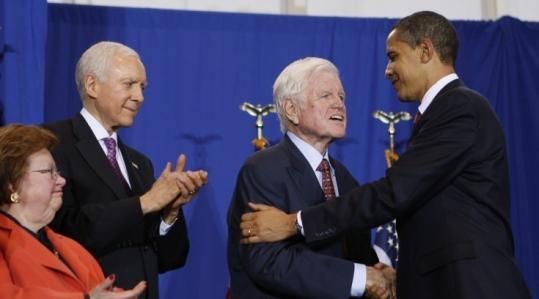
The U.S. Government made a strong effort to encourage volunteerism when it passed the Serve America Act last Year. The legislation, sponsored by the late Edward M. Kennedy, expanded AmeriCorps and put in place a system to provide generous scholarships to students of all ages who undertake certain volunteer activities. Of particular interest to me was the principal objection voiced by those who opposed the bill. A Boston Globe article printed right after the passage of the bill quoted Gene Healy, president of the Libertarian Cato Institute, as saying, “[The Bill offers] more carrot than stick, subsidizing volunteerism rather than mandating it."

President Obama greets Senator Kennedy as Senators Orrin Hatch and Barbara Mikulski watch at yesterday's bill signing.

This strikes me as a curious criticism. I do not understand why providing financial support for volunteerism is a bad thing. Furthermore, I do not understand how mandating volunteerism is a good thing. Making volunteerism mandatory would obviously mean the performance of a lot of public service. The quality of service work suffers, however, if it is being performed simply because it is compulsory. Public service needs to be undertaken by those who possess a genuine desire to help others. Providing financial incentives for public service gives those who possess such a desire the means to pursue it.

We cannot know, at this point, the extent to which the Serve America Act will provide impetus for a new crop of public service professionals. The Act, however, seems to me to take the proper approach to motivating volunteerism, despite what its critics say. If you agree, then an important question becomes how to motivate more legislative initiatives in the mold of the Serve America Act.

Government Social Innovation Fund: Strings Attached?

Obama's $50 million Social Innovation Fund seems to have good intentions, but there are causes for concern. I applaud Obama for the initiative but my main question is, what strings are attached to the money being lent?

As I read through several blogs and articles about this fund, other questions came to mind.

How good is the U.S. government at running these types of programs?
Will the government dicatate how money is spent?

When the government gets involved, even with good intentions, we know it can get messy. Looking at the financial crisis, we saw the U.S. government taking ownership in companies like Goldman, AIG, and GM among others. Through regulation they influenced the decisions made by these companies. Intervention was important because the system wasn't working and it prevented a total meltdown of the U.S. economy. However, it also eliminated the "free hand of the market" and stinted capitalism. Will the U.S. Goverment decide how the $50 million is spent by these non-profits or do they give them free reign once the money is handed out?

In the case of the government acting as an enabler to social innovation, isn't it better to teach a man to fish than to give him a fish? Instead of donating $50 million to a few pre-approved organizations, wouldn't it be better to fund development for the inefficient capital market system that exists in social innovation?

The government doesn't know how to run these types of programs. Let’s use the US Postal Service as an example. The US Postal Service lost $2.8 billion dollars in fiscal 2008. They also had a “capital deficiency” of $1.67 billion in 2008. We might assume that this lackluster performance could be blamed on the industry. Not so. FedEx had 2008 revenues of $37 billion and UPS has fared even better with $51 billion in 2008 revenue.

I'm happy the U.S. Government is willing to provide resources for furthering social innovation. It's a difficult task. Another classmate wrote about the "unintended consequences" of some social innovation ventures with an example of someone donating 1 million tshirts and hurting local sellers. Funding existing non-profits or creating too many policies may also cause "unintended consequences". I think we can do a better job of understanding the flaws in the current capital market system in social innovation and then providing a solid infastructure for growth to that system.